Here is the video link to the story below:
Why I'm Telling This Story
For twenty years, I trusted a man who had known me since childhood — a man my parents considered family. He was my psychiatrist. And when I finally confronted the truth about what he had done to me, he tried to have me arrested.
I'm telling this story carefully and chronologically, because without the full context, what happened later can't be understood.
This is not simply a story about a psychiatrist who made mistakes.
It's about a decades-long family relationship that should have made ethical care more important — and instead blurred boundaries and eroded accountability.
It's about how trust, history, and professional authority can be misused.
And it's about what happens when someone who has influence over your mental health, your medication, and your family narrative chooses self-protection over responsibility.
Before I Was Ever a Patient
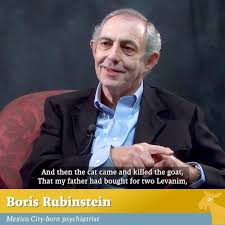
Boris Rubinstein was not a stranger to my family.
My mother grew up with him in Mexico City her parents and his parents were good friends. His eldest sister, Jackie, was my mother’s closest friend, and their families were deeply intertwined. When Boris later moved to New York and became a psychiatrist, he also became a colleague and close friend of my father — who was himself a psychiatrist.
By the time I was a child, Boris was simply "Bubi."
He was a familiar and trusted presence. Someone who came to our home. Someone my parents socialized with. Someone whose role in our lives felt stable and safe.
That history matters — because it explains why I trusted him years later.
In 1999, I was depressed.
My father suggested that I see Boris.
I hesitated. Even then, something felt uncomfortable. This was a close personal friend of my parents. I remember asking, "Is that really an appropriate relationship?"
My father answered with words that would shape what came next:
"I cannot imagine anyone I would trust more to take care of my son than Bubi."
At the time, that reassurance made sense. I had always liked Boris, and I believed that the personal connection might even result in more careful, attentive treatment.
So I agreed to see him.
Only much later did I understand how mistaken that assumption was.
What I did not consider for many years was that Boris's sister Jackie and his wife Halina had long been estranged from my mother, and that neither had any relationship with her during the entire period I was his patient.
At the time, I believed those family conflicts were unrelated. My mother continued to like Boris and never held those estrangements against him. I assumed they had no bearing on my treatment.
After I ended care, I began to reexamine our twenty-year relationship in light of that broader family history.
What became clear to me was that the treatment I received caused profound suffering — suffering that affected not only me, but my mother as well.
Coming to that realization was deeply unsettling.
What followed was nearly twenty years of treatment — or, more accurately, nearly twenty years of mistreatment.
During that time, Boris prescribed me more than fifty psychiatric medications. At various points, I was taking seven drugs at once.
At the center of it all was Klonopin — a powerful, physically addictive benzodiazepine intended for short-term use. Boris prescribed it to me at extremely high doses and kept me on it continuously for twenty years.
I questioned it again and again.
Each time, I was reassured.
I trusted him.
When I felt worse instead of better, I assumed my depression was unusually severe or resistant to treatment. It never occurred to me that the treatment itself was the source of my suffering.
Over time, my life fell apart.
My mental health deteriorated.
My physical health declined.
My finances collapsed.
At thirty-eight years old, I became an alcoholic.
People don’t suddenly become alcoholics at thirty-eight unless something else is profoundly wrong. I was using alcohol to blunt the misery caused by the drugs I had been prescribed. Of course, at the time I didn’t realize that the misery was caused by the very drugs he was prescribing. But Boris knew.
There were years of despair — years of waking up most mornings wishing I hadn’t survived the night.
And through all of it, I believed Boris was trying to help me.

The Boundary That Should Never Have Existed
For nearly the entire time I was his patient, Boris did not bill me.
After about three months of a reduced fee — which I never asked for — he simply stopped charging me. I never requested professional courtesy. He imposed it unilaterally.
Nineteen years of free psychiatric care.
At the time, I saw this as generosity.
It wasn’t.
It was a boundary violation that eliminated accountability and locked me into dependency. The American Psychiatric Association explicitly warns against professional courtesy because it compromises judgment and leads to poor psychiatric care.
It also keeps the patient trapped.
As long as I was addicted to Klonopin and receiving his prescriptions for free, I wasn’t going anywhere. I had no leverage, no exit, and no meaningful ability to challenge the care I was receiving.
After twenty years on massive doses of Klonopin, my primary care physician said:
“You cannot stay on this drug. It’s destroying you.”
By that point, I had been silent for years. I didn’t confront Boris about the damage he had done because he controlled my access to the drug my body depended on. He was my supplier.
That conversation stripped away any remaining illusion.
I understood then that I had no choice but to get off this physically addictive and dangerous drug called Klonopin, a drug the FDA assigns a Black Box warning to, the same warning as for opiates.
After confronting him on the horror I had gotten in him over all those years, he realized I had figured it out.
Following the confrontation, I sent him a couple of emails detailing what I knew I had gotten from him over two decades of well-concealed contempt and reckless prescribing.
So he called me — and I recorded the call.
In that call,Boris says:
“I understand why you are so angry with me.
I understand that I failed you.
I did not take proper care of you, and I profusely apologize. I’m sorry.”
Let me be very clear about this.
No psychiatrist spends twenty years believing he’s provided excellent care — and then suddenly concludes he failed completely — unless he knows exactly what he’s done.
That apology wasn’t confusion.
It wasn’t reflection.
It wasn’t any form of non-defensive listening.
He knew I had him figured out and this was a confession.
The Mask Slips
After that apology, Boris suggested I bring my parents to his office for “closure.”
I brought my father.
What I expected was remorse.
What I got was rage.
In front of my elderly father, the warmth vanished. The empathy evaporated. What emerged instead was hostility and contempt.
He cursed at me.
“What the fuck is this? Original sin?” were his exact words.
That was the moment I understood the person I thought I knew did not exist.
This was the first time I saw the real Boris, the real Bubi.
Ending Treatment and Speaking Out
As I withdrew from Klonopin — a brutal, dangerous process — I began to understand more and more clearly what had been done to me.
I wrote reviews. I wrote him emails – yelling at him in the only way I could for the misery he inflicted on me. I could not go to his office or yell at him on the phone so I yelled at him in writing.
For nine months, he never responded. No call, no email, no letter. He never blocked my email address.
Instead, he printed every email.
He had a great plan to get the reviews taken down.
What He Did to My Parents
Then he involved my parents — both in their eighties.
A few weeks after I posted the reviews, Boris had his wife, Halina, call my mother and suggest the four of them go out to dinner.
That detail matters.
Halina had not had a relationship with my mother for nearly twenty-five years. They were estranged. There had been no contact.
This was not random.
It was not social.
It was not reconciliation.
It was access.
It was a way back into my mother’s life — to re-establish familiarity and trust before what came next.
Months later, Boris and Halina went to my parents’ home.
They brought my private psychiatric emails.
They brought the online reviews I had written.
They sat in my parents’ living room and showed them those documents.
They told my parents I was delusional.
They told them I was dangerous.
They said they had hired a lawyer.
They talked about the police.
They talked about jail.
They told two elderly people that their son could be arrested — not for violence, not for threats — but for writing reviews about a psychiatrist.
That wasn’t concern.
That was leverage.
They knew my relationship with my mother was fragile.
They knew my father was elderly and cognitively declining.
And they used that.
Two people in their early seventies walked into the home of two people in their eighties and frightened them — deliberately — to pressure them into controlling their son and getting those reviews taken down.
That was the tactic: fear.
In those emails, I had written three things about him.
First, that he had contempt for me.
Second, that he was a narcissist.
Third, that our relationship had crossed ethical lines no psychiatrist should ever cross.
With this single act, he confirmed all three.
Handing a patient’s private psychiatric emails to that patient’s mother — after decades of treatment — is not concern. It is exposure. It is humiliation. It is punishment.
And if what we had before was unethical, this took it to an entirely different level of “unethical”.
Because of what Boris and Halina did with my parents, I sued him for breach of confidentiality. After three and a half years, the case made it to trial having survived a motion to dismiss and summary judgment. The court ruled that Boris’s actions, if proven, could constitute a serious and actionable breach of patient confidentiality, and that the claims were substantial enough to be decided by a jury.
What the trial never addressed — and was never allowed to address — was the full scope of what had happened to me over twenty years of treatment, or the broader pattern of conduct that led up to that moment.
It addressed one act:
His decision on February 18, 2020, to deliver my private psychiatric emails to my parents.
Even within that narrow frame, the court ruled that he breached confidentiality, that there were damages that flowed from it, and the case merited a trial.
What the jury never saw was the full damage.
The Affidavits
Early in the lawsuit there were the affidavits.
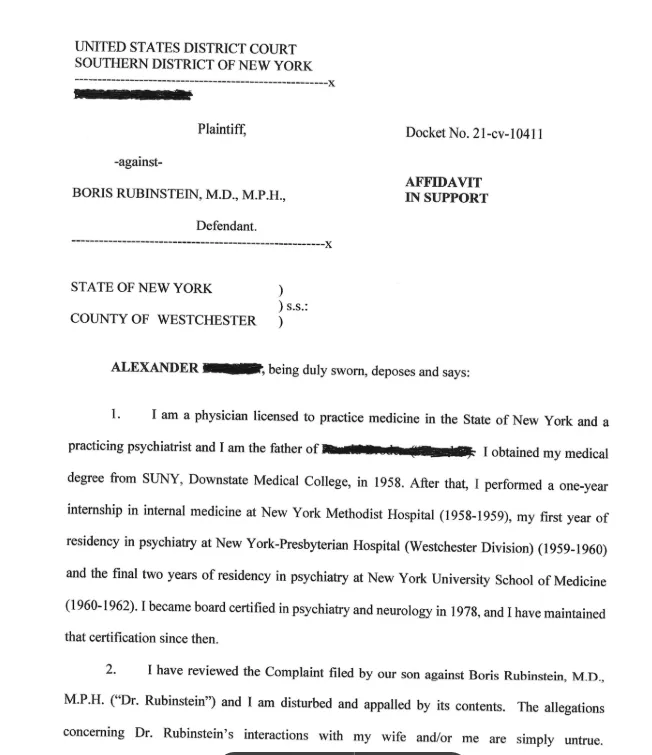
Two sworn affidavits — written jointly by Boris and his lawyer and presented to my parents.
Each one contained four false statements.
Under oath, Boris later admitted that the statements in those affidavits were false.
My father was 89 years old at the time and in cognitive decline.
These were sworn legal submissions — used to get my lawsuit dismissed.
And they were put in front of two elderly people as though they were the truth.
Boris was not just defending himself in court.
He was asking my parents to stand behind documents that contained statements he knew were untrue.
He was asking a father who had always had a close relationship with his son to help defeat that son in court.
Not only was he asking my father to betray me, but to commit perjury by signing false affidavits.
The Escalation
A few days after Boris and his wife went to my parents’ home with my private psychiatric emails, he escalated again.
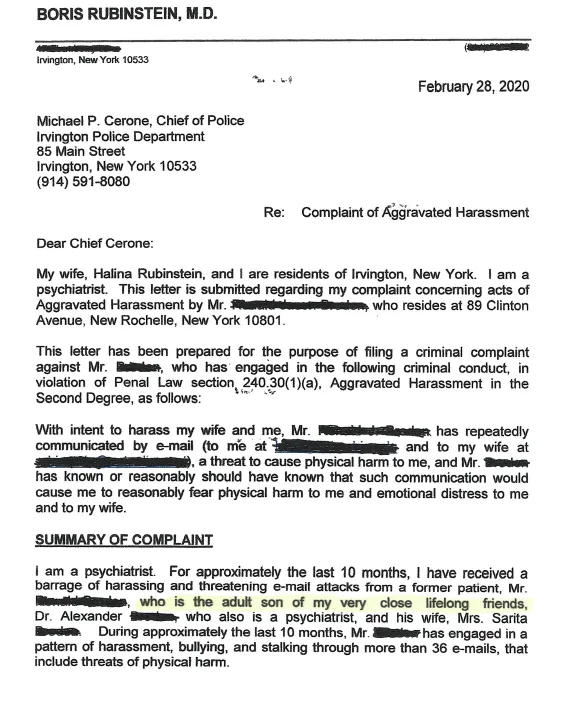
On February 28, 2020, Boris Rubinstein filed a police report after my parents’ involvement failed to get the reviews taken down.
This was not confusion. It was not fear. It was not a misunderstanding. It was deliberate.
The police report contained multiple false statements — statements Boris later admitted under oath were false. And in that report, he asked the police to arrest me.
Arrest me for sending emails. Arrest me for posting critical online reviews.
This was not a stranger calling the police. This was not a casual acquaintance. This was my psychiatrist of twenty years.
A man who had known me since I was five years old. A man who had shared monthly dinners with my father for decades.
In the police report itself, he described my parents as his “very close lifelong friends.”
That phrase matters, because in the same document — just pages later — this same man formally asked the police to arrest their son.
Their son. His patient of twenty years. Someone he had treated since 1999. Someone he had known since childhood.
Not for violence. Not for threats. Not for stalking. But for emails he never responded to and reviews criticizing his professional conduct.
Here is the contradiction, in his own words.
On one page: “the son of my very close lifelong friends.”
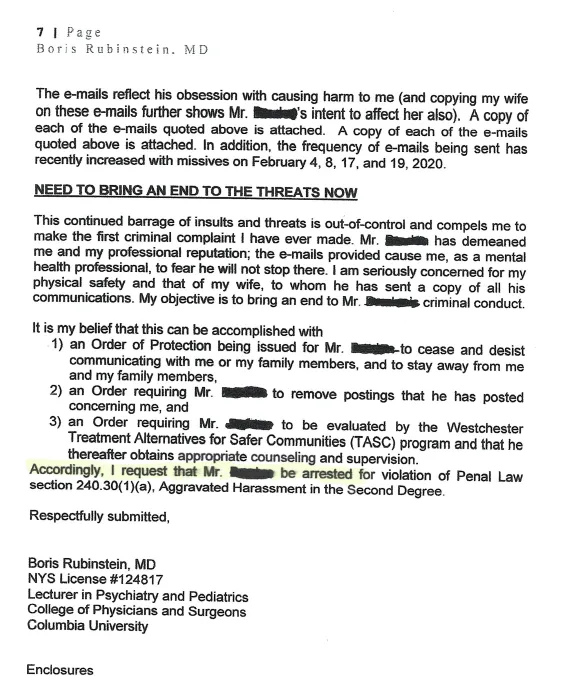
On another: “Accordingly, I request that their son be arrested.”
That contradiction is not accidental.
In the police report, Boris said I threatened him physically. That’s false.
He said I was stalking him. That’s false.
He said he was afraid of me. Also false.
These weren’t misunderstandings. They were lies.
And he had one goal: to get my reviews taken down — reviews that were hurting his practice and that I had every right to post after what he did to me over twenty years of using his prescription pad as a weapon.
Then you get to the last page of the report, and it gets even uglier.
There, he asks the police not just to make me take down the reviews, but to force me into Treatment Alternatives for Safer Communities — a program meant for drug addicts who commit street crimes. The kind of program courts use to keep offenders off the street and out of jail.
I wasn’t charged with a crime. I wasn’t accused of violence. I wasn’t a street addict.
But suddenly my psychiatrist of twenty years is talking like an expert on criminal diversion programs, trying to paint me as someone who belonged in that system.
That didn’t come from treatment. It didn’t come from concern. It came from strategy.
Find a program. Drop the name. Sound authoritative. Make me look as bad as possible on paper.
That’s what this was. An attempt to turn a former patient into a criminal.
And if you’re wondering what kind of person does that, here are the symptoms:
No empathy. No concern for the damage being done or the welfare of others. Manipulation, exploitation, coercion, control. Pathological lying and superficial charm.
And a calm, professional tone while doing it.
That was the pattern for twenty years.
This police report is just where it finally showed itself in writing.
In the report, Boris claimed my parents paid for my early treatment. They did not. He claimed I refused to pay a reduced fee. I did not.
He portrayed his decision to provide free treatment as charity, saying he did not want to “abandon” me.
Under oath, he later admitted these statements were false and that other statements in the police report were false too. Even without the false statements, he is writing about my history, confidential information he acquired about me as my treating physician, and using it to manipulate law enforcement to carry out his own personal vendetta.
He also admitted something else. When he went to my parents’ home on February 18, he selectively chose which emails to show them.
Not all of them. Not a fair representation. Only the ones that made me look the worst.
He admitted that he knew I was withdrawing from 20 years of being on the highest doses of Klonopin and that he did not share with my parents or the police the emails describing the agony of that withdrawal.
He admitted that his goal was to make my parents believe I was delusional and dangerous.
And he carried that same narrative to the police.
This was not about safety.
The police told him my emails were not criminal. They told him online reviews are not a police matter. They told him there was nothing to arrest me for.
That did not stop him from trying.
And notice how he did it.
He did not go to the police alone. He went with his wife, Halina — a rabbi.
A psychiatrist and a rabbi, standing together, projecting authority, credibility, and trust.
The message was implicit but unmistakable: You can trust us.
Yet this was the same man who, in the same breath, claimed lifelong friendship with my parents while asking the police to put their son in handcuffs.
And here is what makes it even more disturbing.
Boris continues the monthly dinners with my father that have taken place for forty years. Halina resumed regular lunches with my mother just weeks after I posted the reviews. Now they meet with my parents together, as couples, sharing meals and conversation.
And at the very same time, they are asking the police to arrest their son.
Imagine my father — elderly, frail, cognitively declining — hearing that his son had been arrested.
Imagine my wife, caring for our young daughter, suddenly being told her husband had been jailed.
This wasn’t concern.
It was retaliation.
For twenty years, he controlled my life through the drugs he prescribed. When I stopped being his patient, he tried to control me through fear, authority, and the legal system. Calling the police was not a last resort. It was the next step.
The Email to My Parents
Now I want to show you one of the most painful and revealing documents in this entire story.
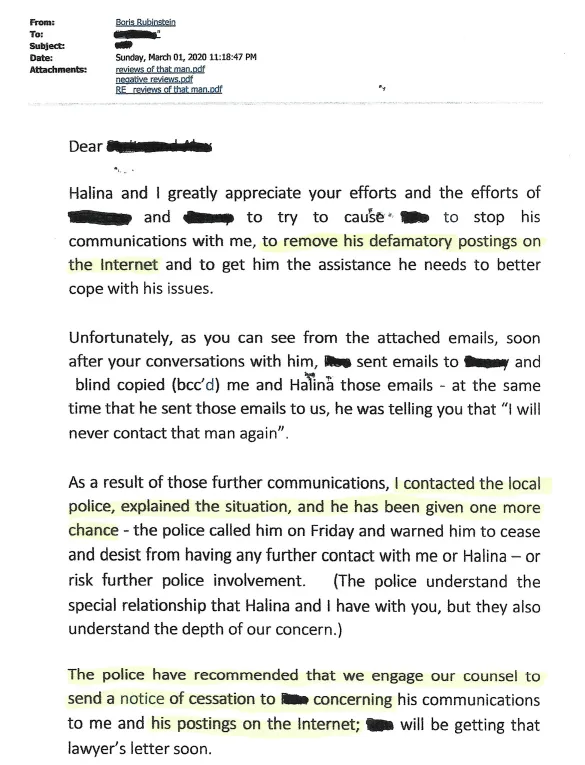
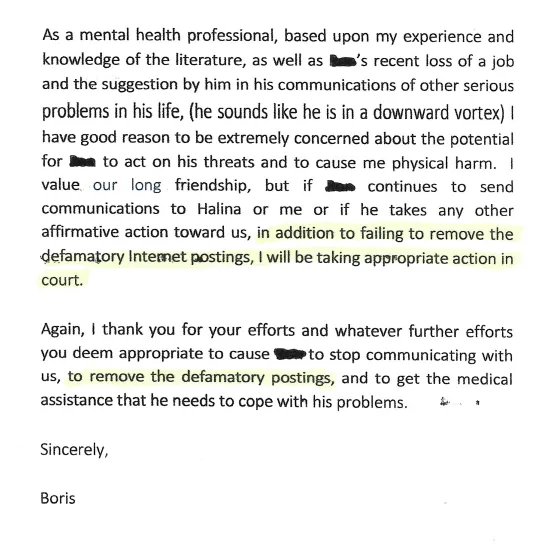
This is the email Boris sent to my elderly parents the day after he went to the police.
As you read it on the screen, pay attention to three things:
the tone,
the framing,
and the story it tells.
In this email, Boris claims the police have “given one more chance.”
He says he is “extremely concerned” that I might cause him physical harm.
He tells my parents that the police “recommended” he contact a lawyer.
None of that was true.
The police told him my emails were not criminal.
They told him online reviews are not a police matter.
They told him this was not a situation for law enforcement.
But he did not share any of that with my parents.
Instead, he presented a version designed to frighten them.
To make two people in their eighties believe their son was dangerous.
To make them believe he was about to be arrested.
To make them fear that he was spiraling out of control.
To make legal — even criminal — consequences feel imminent.
This email was written to shape perception.
And Boris knew exactly where to apply pressure.
He knew my relationship with my mother was fragile.
He knew my father was cognitively declining.
He knew the authority he held in their eyes — as a psychiatrist, as my father’s colleague and longtime friend, as someone they had trusted for decades.
And he used that authority — not to help, not to protect, not to heal — but to pressure, isolate, and punish.
The purpose of this email was clear.
To turn my parents against me.
To make them question my reality.
To make them believe I was a threat.
And ultimately, to silence me.
To make the reviews come down.
Use fear.
Use professional authority.
Use the trust of two elderly parents.
All to achieve a personal goal.
Boris didn’t just involve my parents in person.
This email is proof of what he did after leaving their home.
And look at how often he invokes the phrase “defamatory postings” four times in a relatively short email.
Line after line, he warns two elderly people that their son could go to jail unless the reviews are removed — leaving them terrified and powerless.
The Lawyer Letter
And this… this is what arrived next.
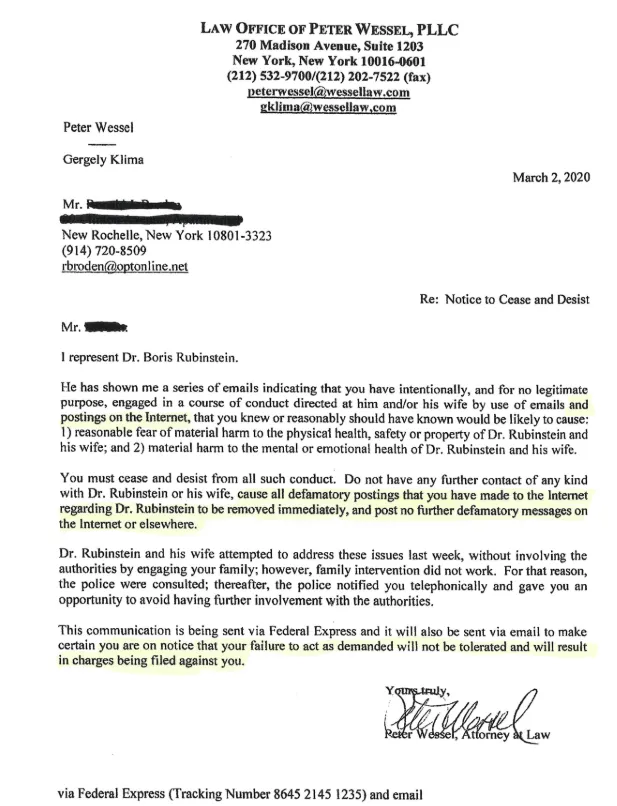
A formal cease and desist letter from his attorney — sent immediately after the police declined to act on his report and after the threatening email to my elderly parents didn’t get the reviews removed.
Look at how it’s framed.
The letter claims that my emails and my online reviews caused “fear,” “harm,” and “danger.”
It warns me that if I don’t stop communicating — and if I don’t remove the reviews — I could face “charges.”
Yes, criminal charges.
This wasn’t about safety.
This wasn’t about concern.
This was about silencing criticism.
And look at the timing.
Ten days after he and his wife went to my parents’ home with my private emails…
Two days after he filed a police report full of false statements…
The very next step was to escalate to a lawyer — to threaten me with criminal consequences for speaking publicly about my experience.
This letter wasn’t written to me as a former patient.
It wasn’t written to me as someone he had known since childhood.
It wasn’t written to me as the son of his “very close lifelong friends.”
It was written to me as a problem to be eliminated.
The goal was simple:Make the reviews disappear. Make the criticism disappear. Make me disappear.
He sent a lawyer after me. And this letter — this document — is the proof.
I believe that for twenty years, I became a stand in — a proxy — for unresolved family conflict that had nothing to do with my care and everything to do with power.
That I was, in effect, payback for perceived wrongs involving my mother, Boris’s sister, and his wife — both of whom had fallen out with her long before I ever became his patient.
That the pain inflicted on me was a way to reach someone else.
I cannot prove motive. But motive is not required to see a pattern.
I am not asking anyone to take my word for this. I am asking you to look at the record.
Look at the documents. Look at the apology. Look at the police report. Look at what was admitted under oath. Look at the emails sent to my elderly parents. Look at the lawyer’s letter. Look at the timing.
Everything that happened after I ended treatment mirrors the twenty years that came before it.
TThe moment I spoke publicly about what had happened, Boris did not reach out to the patient he had treated for two decades, had known since childhood and who was the son of lifelong friends.
Instead, he mobilized pressure.
In his own documents, the reviews were mentioned repeatedly — six times in the police report, four times in the email to my parents, and again in the letter from his attorney.
The message was unmistakable: the goal was not to resolve harm. The goal was to silence the person who described it.
My emails to him were never answered because they were never meant to be answered. They were being collected — printed, preserved, and used as tools to manipulate others.
While I was reaching out to the man who had controlled my medical care for twenty years, he was building a case against me.
What happened after treatment did not contradict the previous twenty years.
It confirmed them.
For two decades, a man who controlled my medications, my diagnosis, and my perception of reality held extraordinary power over my life.
Power over my body. Power over my health. Power over my ability to function. Power over how my own family understood what was happening to me.
And what makes this even more devastating is the contrast between the image Boris projects and the reality I lived. For most of my life, he came across as warm, gentle, and deeply empathic — the kind of person you would trust without hesitation. That façade was convincing. .
But the person behind that façade is nothing like the person he presents himself to be. The harm I endured did not come from someone openly hostile. It came from someone who appears kind. And that contrast — that split between appearance and reality — is what made the experience so damaging. The worst suffering I have ever lived through came from the person I least expected it from.
During the years I was under his care, my health collapsed. I suffered serious physical consequences, including a heart attack. My ability to function deteriorated. My finances disintegrated. I went through bankruptcy.
This was the cumulative result of years of dependency, overmedication, and untreated harm.
And when that authority finally ended, the methods changed.
The prescription pad was replaced by intimidation. Clinical authority was replaced by institutional pressure.
But the objective remained the same.
Control. Punishment. Silence.
I survived this. Barely.
Others may not.
That is why this record is now public.